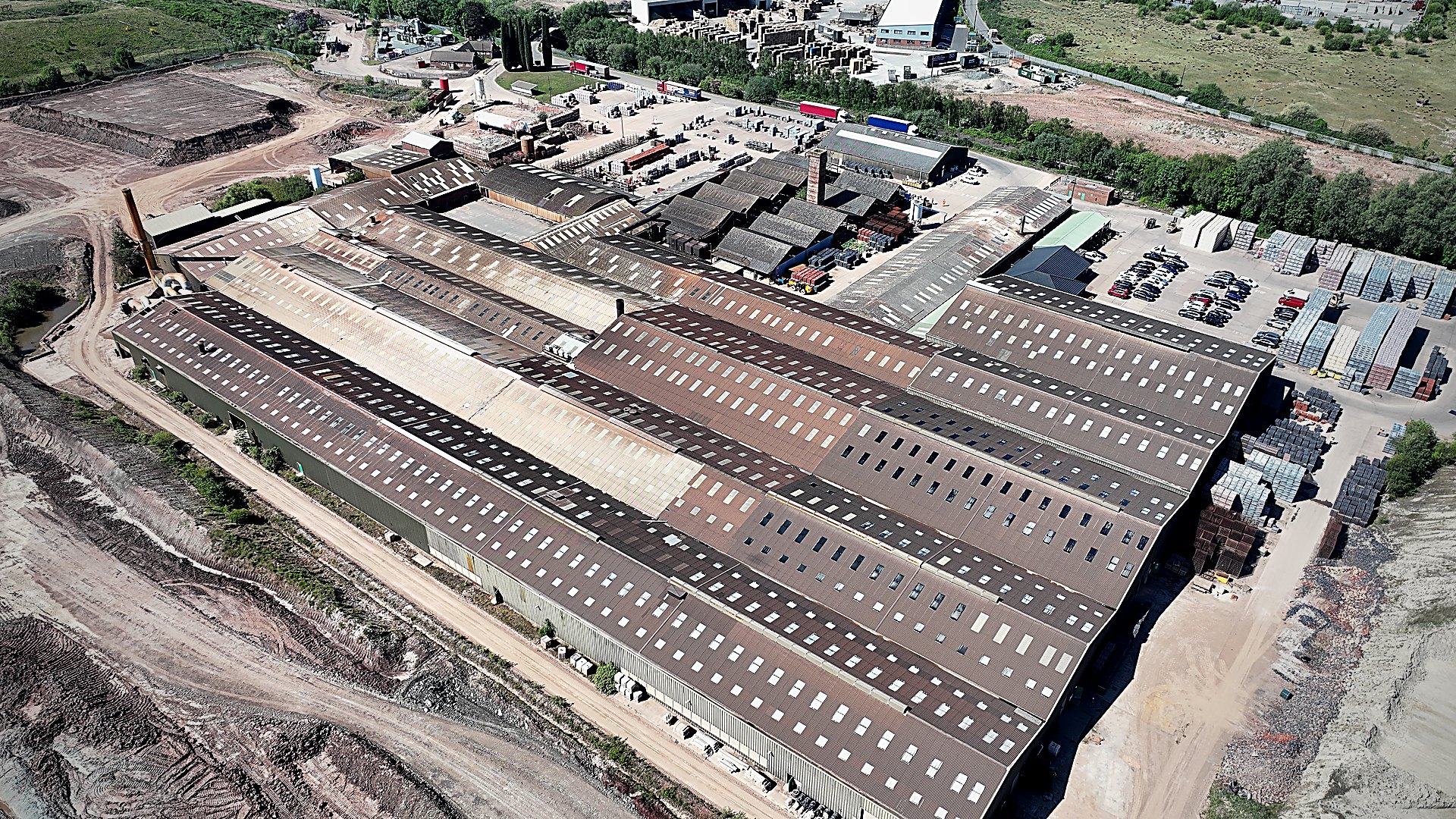
Asbestos cement sheeting stops more commercial solar schemes than any other single covering, and the reason is not the one most people expect. It rarely fails on the weight of the array. It fails on wind uplift, and the fixing detail is the part that gives way.
10Paper numberOpenNo registrationQuotableAttribution required6 minRead time
62
% of asbestos cement roofs in our 575-roof dataset failed wind uplift assessment.
1 in 10
Roofs in that dataset were roofed in asbestos cement.
0
Of them can be loaded for access, which changes how the survey is carried out.
01 · The mechanism
The array does not push down, it pulls up
An array on a roof plane alters the airflow across it and generates suction, concentrated at edges and corners. That suction is resisted by the fixings holding the sheet to the structure beneath.
The published figureAcross 575 UK commercial rooftops assessed between 2024 and 2026, asbestos cement accounted for one roof in ten, and 62% of those failed wind uplift assessment. Both figures are published in full, with method and limitations, on the PV Structural Feasibility Dataset.
The sheet is brittle and the fixings are old
Asbestos cement has low tensile capacity and does not deform before failing. The fixings through it are commonly of the same age as the sheet, have corroded, and were detailed for a roof carrying nothing but itself. Neither element was designed for a sustained uplift demand applied at discrete points.
Which is why weight is the wrong thing to calculate
The dead load of modules and mounting is modest, and a calculation confined to it returns a comfortable answer. The governing case is the combination under BS EN 1990, with wind actions to BS EN 1991-1-4 and its UK National Annex and array uplift derived using BRE Digest 489. The uplift is what the fixings must resist, and the fixings are what fails.
And the failure is not gradual
A brittle sheet with a corroded fixing does not degrade visibly toward failure in a way that an inspection from the ground will catch. This is a material where condition and capacity are not the same enquiry.
Figure 1
The finding, and the mechanism behind it
Measured proportion, schematic mechanism. 62% is drawn from the asbestos cement roofs within the 575-roof dataset. The diagram alongside illustrates why they fail: uplift is resisted at the fixings long before it reaches the frame, and on a fragile sheet with ageing fixings that is where the capacity runs out.
02 · What it does to the survey
Method has to change before scope does
Nobody goes onto the sheet
The covering will not safely bear a person. The condition of the covering is therefore recorded from the air, and the structural arrangement is recorded from below, in a single attendance. This is a method constraint, not a reduction in what is established.
The fixings are the decisive unknown and the hardest to see
Their condition where they pass through the sheet governs the answer and cannot be established from either vantage without opening up. Where that is the case, the report should say so rather than infer it — on this material an assumed fixing condition is the assumption most likely to be wrong.
Rooflights deserve separate mention
They are frequently the most fragile element of the roof, are often the same profile and colour as the sheet around them, and are not reliably distinguishable from above.
03 · What follows
A finding, not a verdict
Failing uplift does not always end a scheme
It ends the scheme as drawn. Revised layout that keeps modules out of the highest-suction zones, a different mounting approach, or replacement of the covering as part of the works are all routes that have been taken. Which is appropriate depends on the building and on what else the roof needs.
And the finding has value beyond the array
A covering that cannot resist array uplift is a covering with an identified condition and fixing problem. That is worth knowing regardless of whether solar proceeds, and it is frequently the first time anybody has established it.
How Solar Surveys approaches this
The roofs that fail this test are the ones we are built to assess
Asbestos cement is where the access problem and the structural problem arrive together, and it is where a lot of feasibility work quietly gives up. Solar Surveys handles these roofs as routine, because handling them was the reason the method was designed the way it is.
01
Assessed without ever touching the sheet
The covering is inspected from the air and the structure from below. Nobody stands on a fragile sheet, and no access installation is needed to get a complete picture of both halves.
02
Uplift assessed properly, at the fixings
Wind actions to BS EN 1991-1-4 and its UK National Annex, array uplift derived using BRE Digest 489, and the check taken to the fixings and the sheet rather than stopping at the frame. That is where these roofs actually fail.
03
A clear answer, including when it is no
Where a roof will not carry the array, we say so and explain what governs. A clear negative early is worth considerably more than an optimistic maybe that collapses at the pre-installation stage.
Where a covering will not take the uplift, the honest answer arrives before the scheme is designed around it, not after.
Solar Surveys Ltd · structural surveys and roof condition assessments for commercial solar PV across the UK · £5m professional indemnity cover in force.
04 · Basis and limitations
How this paper was prepared
Basis
The 62% and one-in-ten figures are drawn from the PV Structural Feasibility Dataset 2026, covering 575 UK commercial rooftops assessed between 2024 and 2026. Method and limitations for those figures are published on the dataset page.
Standards referenced
BS EN 1990; BS EN 1991-1-1; BS EN 1991-1-3; BS EN 1991-1-4 with the UK National Annex; BRE Digest 489.
Scope
Commercial and industrial roofs in the United Kingdom clad in asbestos cement sheeting.
Not guidance on asbestos management
Identification, sampling, management and removal of asbestos-containing materials are separately regulated disciplines. Nothing in this paper addresses them.
No failure rate by fixing type
The dataset records the outcome, not a breakdown by fixing type or age. No such breakdown is published here.
Assessment is per building
A published proportion describes a population. It does not indicate the outcome for any individual roof.
05 · Citation
Cite this paper
Suggested citation
Raihan, S. (2026) Asbestos Cement and the Uplift Failure. Solar Surveys Research, Paper 05. Solar Surveys Ltd. Available at: https://solarsurveys.co.uk/research/asbestos-cement-and-the-uplift-failure