ELECTRICAL SURVEYS FOR SOLAR PV
Solar Surveys conducts in-house electrical surveys for commercial solar PV: MPAN analysis, main incomer capacity assessment, switchgear condition, inverter location and G99/G98 DNO application management from submission to connection agreement. Available UK-wide as part of a combined pre-construction package alongside on-site structural surveys, drone roof condition assessments and solar design under a single instruction.
WHY COMMISSION THIS INDEPENDENTLY?
The G99 Problem No One Talks About
Most EPC contractors have an electrical subcontractor who handles G99 submissions. The problem is that subcontractor submissions are frequently returned by the DNO for incomplete technical data, missing protection relay schedules, or load calculation format errors. These delays sit on the critical path and prevent commissioning.
Our electrical surveys are specifically scoped to produce G99-ready documentation on first submission, formatted to the DNO's technical requirements, with all supporting structural data produced by the same engineering team. This removes the most common cause of application rejection and keeps commissioning off the critical path.
WHAT WE DO
Electrical Infrastructure
Assessment. End to End.
Commercial solar PV installations require detailed knowledge of the building's existing electrical infrastructure before a system can be designed or a DNO application submitted. Most sites have not been assessed for solar generation capacity, and the gap between what the grid will accept and what the building can absorb is a critical pre-construction data point.
Our electrical surveys assess the existing main incomer, MPAN registration, switchgear capacity and condition, and the optimal inverter location: giving your design team the electrical parameters they need before the CAD layout is drawn. G99 or G98 DNO application management is included as standard, tracked through to connection agreement under the same instruction.
SCOPE OF ASSESSMENT
Every Electrical Variable
Your Programme Depends On.
MPAN Analysis
Meter Point Administration Number analysis confirming the existing grid supply reference, tariff class and registered capacity: the foundation of any G99 or G98 application submission.
Main Incomer Assessment
Physical inspection of the main incomer, fuse size, supply voltage and connection point condition: establishing the baseline capacity against which the solar generation system will export or self-consume.
Inverter Location Assessment
Optimal inverter location assessed against cable run lengths, ventilation requirements, access constraints and proximity to the main distribution board: minimising losses and installation cost.
Switchgear Condition Report
Visual inspection and condition assessment of the existing switchgear, distribution boards and metering. Any equipment requiring upgrade or replacement prior to solar connection identified and costed.
Export & Self-Consumption Capacity
Analysis of the building's baseload demand profile against the proposed generation capacity: determining the optimal export limit and whether a Smart Export Guarantee or export limiting is required.
G99 / G98 Application
Technical application to your DNO prepared, submitted and managed through to connection agreement. All technical queries handled by our electrical engineers without your team's direct involvement.
Detail Electrical Design
From Survey to Installer-Grade Electrical Design.
Beyond the survey, Solar Surveys produces the full LV electrical design package: cable sizing, selectivity studies, protective device coordination, AutoCAD drawings, and quality assurance for the installation phase.
LV Design Report
- . Cable sizing calculations: minimum CSA, fault current withstand, voltage drop, voltage rise
- . Selectivity (discrimination) studies across protection devices
- . Circuit protective device settings and coordination
- . Detailed Single Line Diagrams tailored to the existing electrical infrastructure
- . Containment layouts and 2D elevation drawings
- . BS 7671 (IET Wiring Regulations) compliant throughout
Site Surveys + QA
- . Electrical site surveys for concept designs (project costing and planning)
- . Electrical installation project management and contractor engagement
- . Quality assurance for electrical and Solar PV installations
- . Verification of 3rd-party electrical designs
- . On-site DC inspection and testing post-installation
- . I&V curve testing on the PV DC side, with handover sign-off documentation
Software Stack
- . Trimble Pro Design (electrical design)
- . Electrical OM (operations management)
- . ETAP (power systems analysis)
- . AutoCAD (2D / containment drawings)
- . Relux (lighting design where required)
- . Industry-aligned tooling, in-house engineering judgement on every output
G99 Application . What We Compile
DNO Submission. Documents Compiled.
A G99 application is required for any generation asset above 16A (3.86kW) single phase, or any energy storage connection. Solar Surveys compiles every input the DNO needs for sign-off.
RfG Generator Type Bands
- . Type A: greater than 800W and less than 1MW
- . Type B: 1MW to less than 10MW
- . Type C: 10MW to less than 50MW
- . Type D: 50MW or above, or Connection Point above 110kV
- . The European Requirements for Generators (RfG) code defines these bands; correct typing drives the application track.
Inputs We Compile
- . Full site address and on-site electricity contact
- . Full MPAN number(s)
- . Single-phase or 3-phase confirmation
- . Panel count, model, and data sheet
- . Inverter make, model, count, data sheet, and G99 certification
- . Aerial site image with installation pin and meter location
- . Signed Letter of Authority
- . Existing installation details (for sites with prior PV)
- . G99 relay panel design where the proposed inverters are not G99-compliant out of the box
Real Engineering Deliverables
What the finished package looks like.
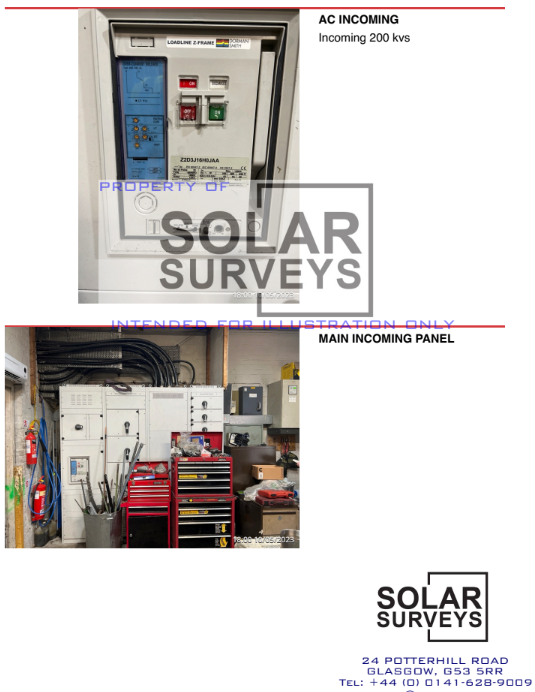
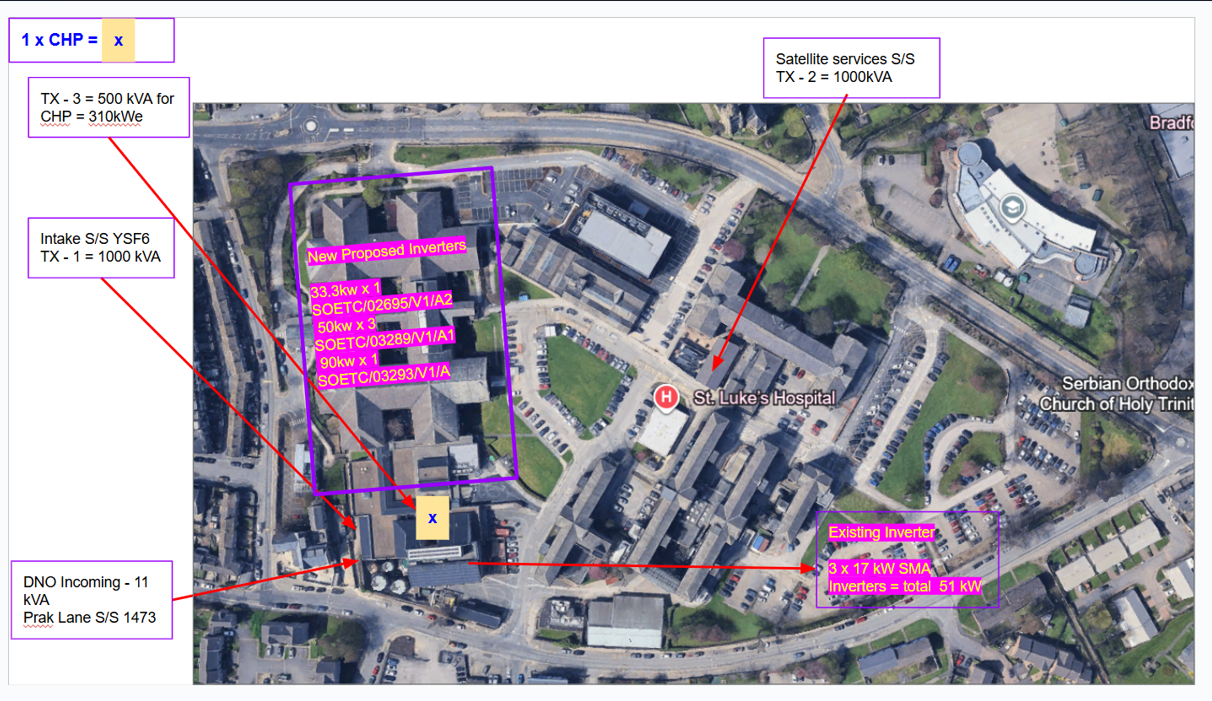
Anonymised samples from real Solar Surveys electrical surveys and DNO applications. On-site photography, network arrangements, protection studies and inverter SLD overlays.
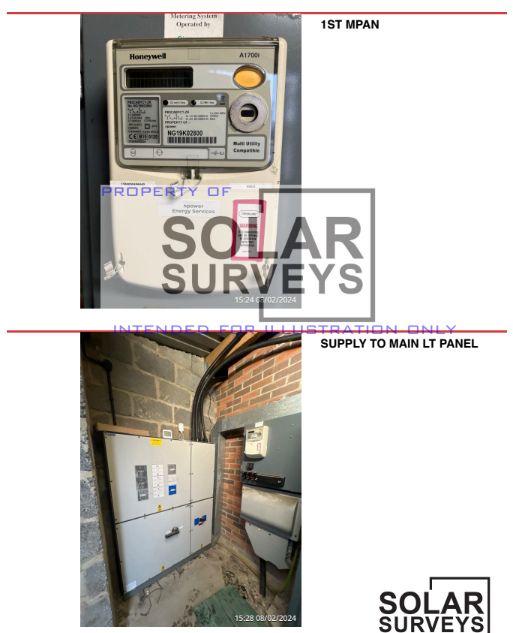
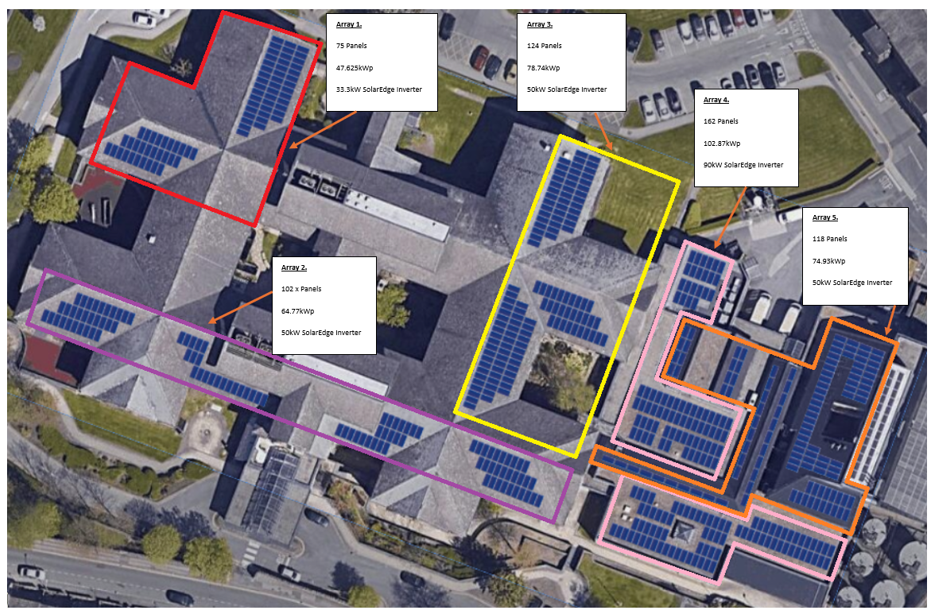
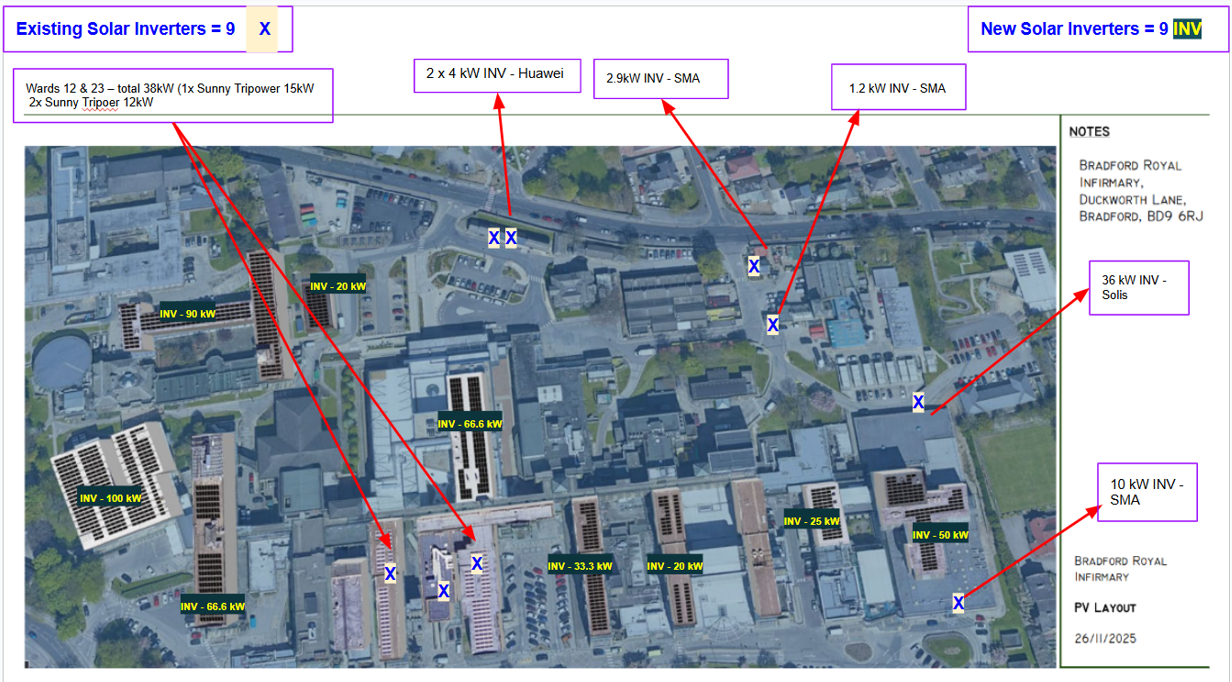
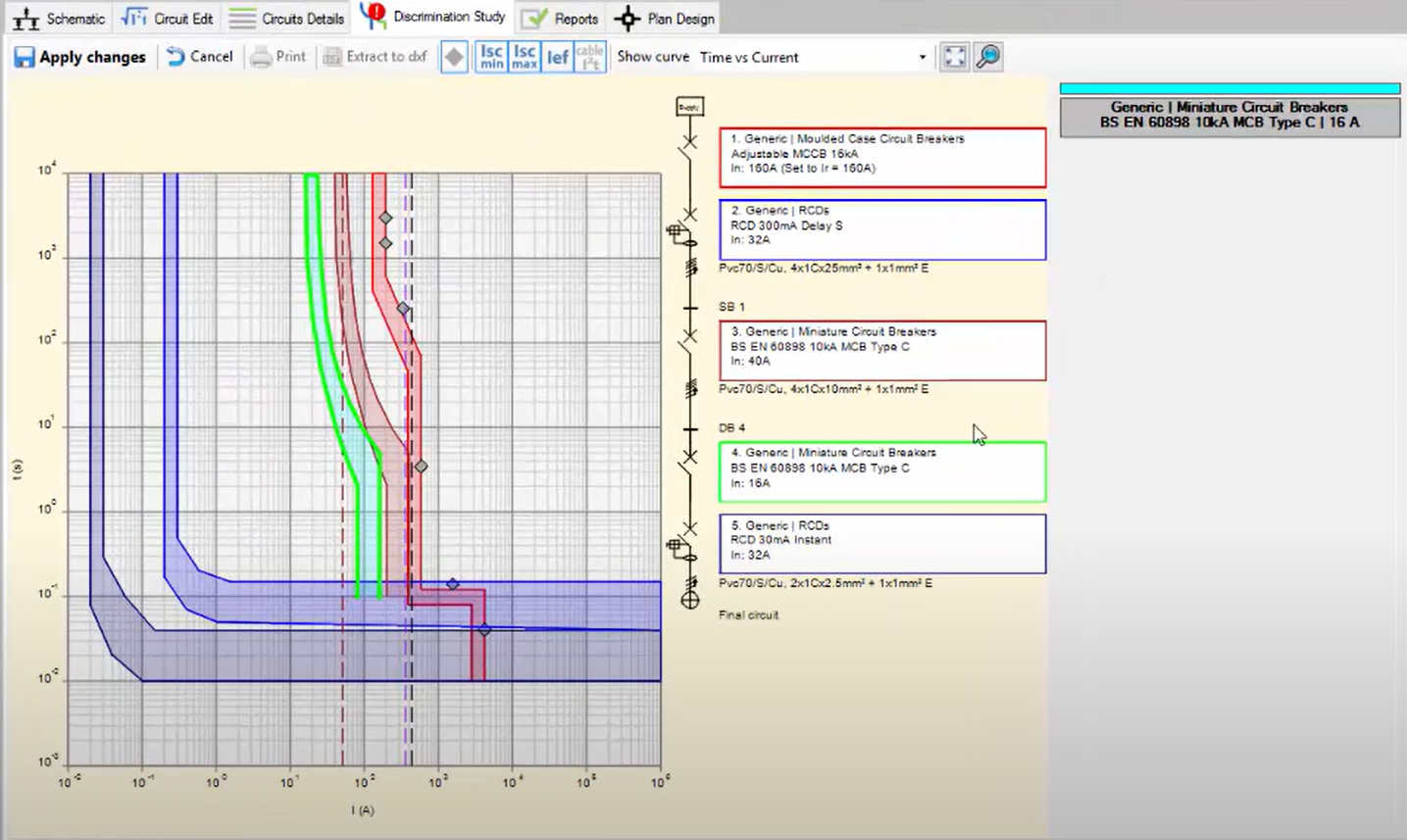
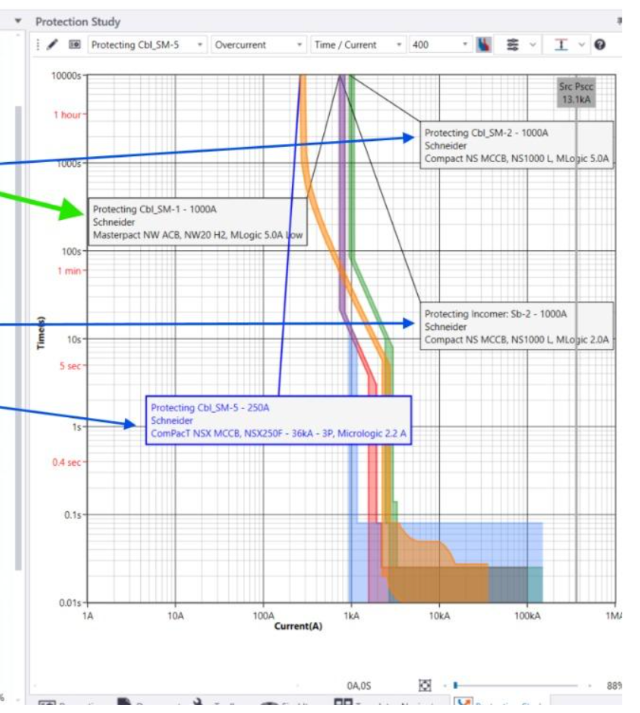
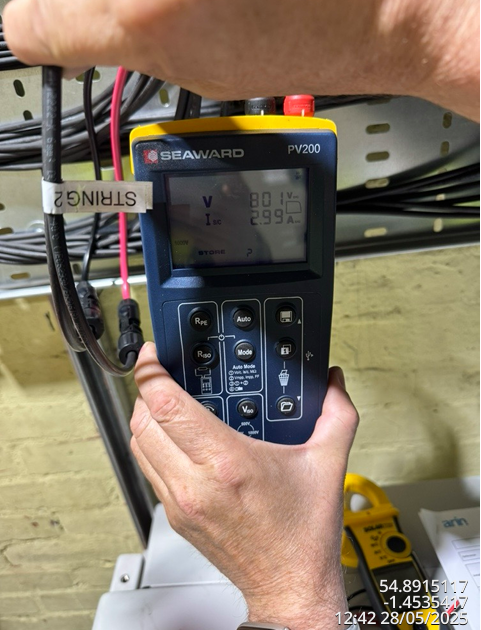
All deliverables shown are anonymised samples watermarked for illustration. Live deliverables are unwatermarked and client-branded.
HOW IT WORKS
From Site Visit to
Connection Agreement.
Site Electrical Survey
Our electrical engineer visits the site to conduct the full infrastructure assessment: main incomer, switchgear, inverter location options, MPAN verification and condition report.
Survey Report & Parameters
Survey findings compiled into a structured report covering all electrical parameters: incomer capacity, switchgear condition, recommended inverter location and export capacity analysis.
DNO Application
G99 or G98 application prepared and submitted to the relevant DNO. Application references the survey findings and solar design specification: submitted as a complete, pre-checked technical package.
Connection Agreement
DNO technical queries managed and responded to by our engineers. Connection agreement issued and forwarded directly to your programme team: ready for your installer and commissioning engineer.
Client identities and project specifics are withheld under NDA. Testimonials and case references are presented in anonymous-authoritative format.
"Our installer had been waiting over six weeks for a G99 connection agreement because the original application had been submitted with incomplete technical data. Solar Surveys reviewed the submission, corrected the technical parameters and resubmitted: we had the agreement within three weeks. They now handle all our G99 applications from the outset."
TYPICALLY INSTRUCTED ALONGSIDE
On-Site Structural Survey & Drone Assessment
Most electrical survey clients instruct a structural survey at the same time: structural sign-off and electrical clearance produced as a single pre-construction package under one instruction. Add a drone roof condition assessment where access is restricted or roof condition is unknown.
WHO THIS IS FOR
Handling the Grid Application.
So You Don’t Have To.
Grid Compliance Across Your Portfolio
G98/G99 applications and DNO engagement managed from instruction through to grid connection approval. We handle the electrical compliance process so your portfolio programme keeps moving without stalling at the grid application stage.
Asset Manager Services →High-Volume DNO Submissions
Batch G98/G99 applications for large pre-construction pipelines. Consistent turnaround, single point of contact throughout: built to process volume without creating a bottleneck in your programme flow.
PPA Provider Services →Electrical and Structural in One Instruction
Electrical surveys and DNO applications coordinated alongside structural assessment. Single instruction, parallel output: reducing programme interfaces and keeping your design-to-build timeline tight.
EPC Contractor Services →DNO Applications Handled End-to-End
G98/G99 applications, electrical surveys and DNO grid connection support for commercial solar installations. We handle the compliance paperwork so your installation programme doesn’t stall at the grid application stage.
Solar Installer Services →FREQUENTLY ASKED QUESTIONS
Electrical Survey Questions.
What does an electrical survey for commercial solar cover?
An electrical survey for commercial solar assesses the existing electrical infrastructure, distribution board capacity, metering arrangements, MPAN reference and available export capacity at the connection point. This data drives the inverter specification, determines whether a G98 or G99 application is required and informs the system design to avoid costly post-design electrical amendments.
Why commission an electrical survey before the solar design phase?
Designing a solar PV system without electrical survey data risks specifying inverters or connection arrangements that cannot be accommodated by the existing infrastructure. Electrical constraints discovered after design require redesign, delay DNO applications and add cost. Commissioning the electrical survey at the same time as the structural survey eliminates this risk by grounding the design in verified site data.
Can G99 grid connection applications be managed alongside the electrical survey?
Yes. Solar Surveys manages G98 and G99 applications in-house as part of the electrical survey package. We handle the technical application, protection relay schedule and any DNO correspondence through to connection agreement. G99 applications are submitted to coincide with your programme milestones to prevent grid connection from becoming the critical path delay in your installation schedule.
What is the difference between a G98 and G99 DNO application for solar PV?
G98 applies to generating systems up to 16A per phase, covering most small commercial solar systems connecting to the low voltage network. G99 applies to all larger systems, including the majority of commercial and industrial solar PV, and requires a formal technical application including a protection relay schedule submitted to the DNO before commissioning. Solar Surveys determines the correct application type from the proposed system capacity and electrical assessment findings, and manages submission under whichever standard applies.
Can an electrical survey and structural survey be conducted on the same site visit?
Yes. Solar Surveys co-ordinates electrical and structural site visits to the same site on the same day wherever the programme allows. A combined visit reduces total site access disruption and produces both electrical parameters and structural assessment data simultaneously: enabling the design team to proceed with both outputs from a single instruction. The combined package is the most efficient pre-construction route for any commercial solar programme.
From MPAN to Connection Agreement.
In-House. End to End.
Commission an electrical survey and G99 application as part of your pre-construction package. One instruction: electrical assessment, application and connection agreement managed to completion.