Open Specification · Issue 1
Structural Feasibility
Assessment Specification
What a structural feasibility assessment of an existing roof proposed to carry solar PV should contain, written so it can be quoted directly into a scope of works. Free to adopt, free to quote, no permission needed. It is voluntary, and we certify nobody against it.
What this is
A written specification for the scope, method and deliverable of a structural feasibility assessment. Published so that a buyer can specify one, and compare two, without being a structural engineer.
What this is not
Not a standard issued by a standards body. Not a requirement of the Microgeneration Certification Scheme. Not a certification scheme, and not a mark anybody can hold.
Who it is for
Anyone buying, selling or reviewing this work: installers, EPC contractors, asset managers, funders, insurers and their advisers.
Part 1 · Why this exists
Two assessments can both be correct and share almost nothing
From 18 June 2026, MIS 3002 V6.0 requires the structure to be checked before a solar PV array is installed, on installations within the scope of the Microgeneration Certification Scheme. It requires that check to be carried out by a suitably competent person, and in the cases named below it requires a qualified structural engineer. What it does not do, in either case, is prescribe the method or state what the resulting document has to contain.
That is a reasonable position for a certification scheme to take, and it leaves a practical gap for everyone downstream. A buyer receiving two documents, both honestly produced, both defensible, has no basis on which to compare them. One may be a site-specific analysis under the Eurocodes. The other may be a desk opinion using generic assumptions. Nothing on the cover distinguishes them.
This specification exists to close that gap from the buyer's side. It sets out what to ask for, so that what comes back can be judged.
Why the engineer, then, where the standard does not compel one. A mounting system's load data states what the array demands. It says nothing about whether this roof, at its actual age, in its actual condition, carrying whatever it has accumulated since it was built, can supply it. Answering that is a structural engineering judgement rather than a lookup, which is why we apply the engineer requirement to our own work and recommend it here.
Part 2 · Status and use
Status
This specification is published by Solar Surveys Ltd and is free to use, quote, adapt and embed in procurement documents without permission, licence fee or notification.
It is voluntary. It carries no legal force. Where it conflicts with a regulation, a contract or a standard issued by a standards body, those take precedence and this does not.
Solar Surveys Ltd certifies, accredits, approves and audits nobody against this specification. There is no register, no assessor, no membership, no mark and no fee.This is deliberate. A specification published by a practice that also sells the service should not double as a gate that practice controls.
Conformity is self-declared by whoever carries out the assessment, and is a matter between them and their client.
Nothing here transfers liability. An assessment carried out by another party remains that party's responsibility whether or not it follows this document.
Part 3 · Scope
What is in, and what is not
Applies to the structural feasibility assessment of an existing roof proposed to carry a solar PV array.
Applies to commercial, industrial, public sector, agricultural and multi-residential buildings.
Does not cover new build design, where the array is a design input from the outset rather than an addition to a completed structure.
Does not cover electrical design, grid connection, yield modelling, planning or fire strategy. Those are separate disciplines with their own competence requirements.
Does not cover the condition or remaining service life of the roof covering as a waterproofing element, except where that condition governs whether the array can be fixed or supported. A structurally adequate roof can still be the wrong roof to build on.
Part 4 · Required inputs
What must be established before assessing
An assessment that begins without these is estimating, not assessing. Where an input cannot be obtained, 4.7 applies.
The proposed array. Module type and dimensions, quantity, layout, orientation, tilt, mounting system, and the fixing or restraint method. An assessment cannot be carried out against an unspecified array.
Site location, to sufficient precision to derive site-specific actions, including altitude.Ground snow load rises with altitude under the UK National Annex to BS EN 1991-1-3. A national average understates the action at height, and understates it in the unsafe direction.
Structural information for the existing roof. Original design drawings and calculations where they exist. Where they do not, a physical survey establishing member sizes, spans, centres and the load path.
Roof covering type, approximate age and condition, including whether it is fragile, and whether it can be walked or loaded for access.
Loads the structure already carries beyond its original design intent: services, plant, ductwork, walkways, safety systems, previous overlays or re-covering.
Access and sequencing constraints that determine how, and whether, the works can physically be carried out.
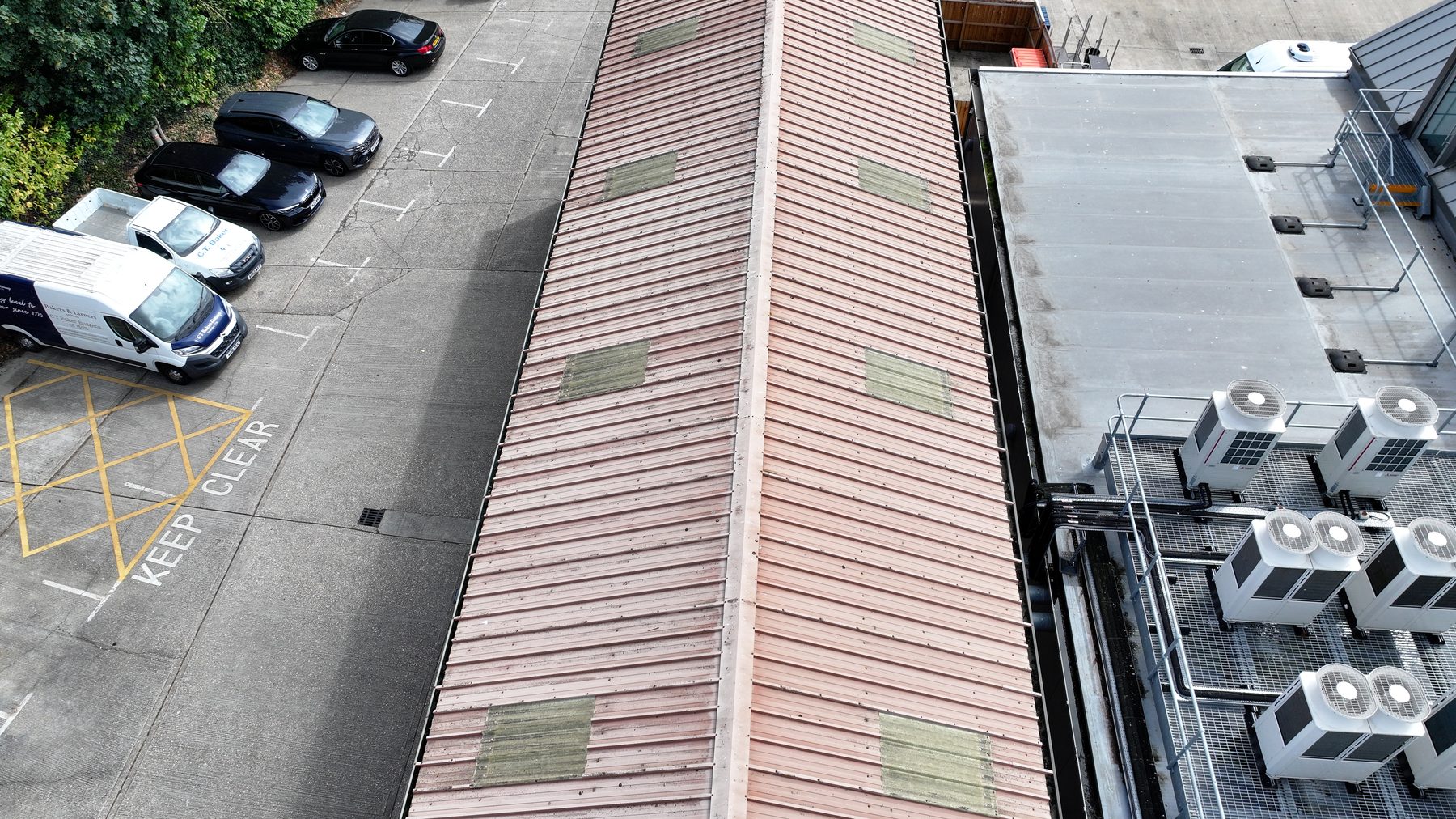
Where a required input cannot be obtained, the assumption made in its place shall be stated explicitly in the deliverable, together with what would change if the assumption proved wrong. An unstated assumption is the most common defect in this work.
Part 5 · The assessment
What must be assessed, and against what
The standards below are those we apply. They are named so that a buyer can ask which were used, and a reviewer can check. Each one is explained in plain English in the Standards Library.
Combinations of actions in accordance with BS EN 1990. The array is assessed in combination with the actions the roof already carries, not in isolation.
Imposed actions in accordance with BS EN 1991-1-1, including access and maintenance loading on a roof that will now be visited more often than it was.Distribution matters as much as magnitude. BRE Digest 489 notes that a change in load distribution can alter the behaviour of trusses, putting members designed for tension into compression and vice versa, and that every fixing introduces a point load. Neither appears in a spare-capacity check.
Snow actions in accordance with BS EN 1991-1-3 and its UK National Annex, derived from the site's own altitude.Drifting is considered against parapets, upstands and adjacent higher roofs, and against the array itself, which creates new obstructions for snow to accumulate against.
Wind actions in accordance with BS EN 1991-1-4 and its UK National Annex, for the specific site exposure.
Array wind uplift derived using BRE Digest 489, revised 2014. Uplift is frequently the governing case, not the added weight.The 2014 revision is written on BS EN 1991-1-4 and its UK National Annex, and gives a safety factor of 1.35 for roof-mounted solar, being a 1.5 partial factor for wind action reduced by a consequence class factor of 0.9 per MCS 012. Cite the edition: the 2004 first edition it replaced predates the Eurocode transition.
Array dead load stated explicitly, with its build-up. Modules, mounting system and ballast are separate contributions and should be shown separately rather than as a single figure.There is no typical value worth publishing. Ballast is derived, not looked up: it follows from the coefficient of friction of the covering, the site wind actions and uplift, and what the structure beneath can safely carry. Assessed systems run from around 0.2 kN/m² to well above it. State the figure for the system in front of you, as a declared ceiling not to be exceeded, and show how it was arrived at.
Where the system is ballasted, the ballast is assessed as a load the structure must carry in the position it will occupy.On a ballasted system the array is held down by weight rather than by penetrating fixings, so the ballast required to resist uplift becomes a governing load. It is not a detail to be resolved on site. MIS 3002 V6.0 clause 5.9.13(e) requires a coefficient of friction of 0.3 unless the material combination has been tested, and 5.9.13(g) requires the calculation to declare the coefficient used. Both belong in the report.
The covering and its substrate are assessed for their ability to accept the proposed fixing or restraint method, independently of whether the frame beneath is adequate.
Where the installation falls within the scope of the Microgeneration Certification Scheme, MIS 3002 V6.0 is considered in addition to, not instead of, the above, including whether the roof falls into a case where the standard mandates a qualified structural engineer (5.9.6, 5.9.13(h), 5.5.5(b)).A flat roof carrying a ballasted array is always such a case. 5.9.13(h) admits no exception.
Where the roof is found inadequate, the assessment identifies what would make it adequate, or states that no proportionate route was identified. "No" on its own is not a finished assessment.
Part 6 · The deliverable
What the buyer should receive
A written report. Not an email, not a verbal confirmation, not a line on a layout drawing.
The named individual responsible for the engineering conclusion, and the basis on which they are competent to reach it, stated plainly enough that a non-engineer can weigh it.
A single unambiguous conclusion per roof, drawn from a defined set of outcomes. See Part 7.
The standards applied, by number, and the array loading used, by value.
Limitations, assumptions, and what was not inspected. Including anything concealed, inaccessible or taken on trust. This section is the measure of an honest report, and it is the section most often missing.
Where remedial work is required, what it is, and what it is for, in enough detail to be priced by somebody who was not on the survey.
Date, revision and the array revision it was assessed against.An assessment is valid for the array it assessed. If the layout, module or mounting system changes afterwards, the conclusion does not automatically carry across.
Part 7 · Outcome classification
Four outcomes, so that two reports can be compared
These are the four we use, and the four the 575-roof dataset is classified against. They are offered here because a shared vocabulary is worth more than a better one nobody uses.
Structure adequate for the array as designed. No changes required.
Viable with design adjustment. Layout, tilt or ballast arrangement revised. No physical works to the structure.
Physical structural works required before installation can proceed.
Structure inadequate. No proportionate route to installation identified.
Part 8 · Use in procurement
Wording you can paste
If this specification is useful to you, the most useful thing to do with it is to require it. The following is free to copy into an enquiry, a scope of works or a tender. It does not name us, and it does not need to.
Suggested clause
The structural feasibility assessment shall be carried out and reported in
accordance with the Structural Feasibility Assessment Specification,
Issue 1 (2026), Parts 4, 5 and 6.
The report shall state the standards applied by number, the array dead
load used by value, the assumptions made, and any part of the structure
not inspected. A single outcome shall be stated per roof in the terms of
Part 7 of that specification.
Part 9 · Citation and licence
Citing this specification
Free to cite, quote and reproduce in full with attribution. No permission needed, no notification required, no fee at any volume. Reproduction should retain the attribution and the issue number, so that a reader can identify which version they are working to. If a clause does not fit your use, tell us, and it will be considered for Issue 2.
Solar Surveys Ltd (2026). Structural Feasibility Assessment Specification, Issue 1. Sahir Raihan, Managing Director.
https://solarsurveys.co.uk/assessment-specification
We wrote the specification because
we work to it.
Every assessment we issue follows Parts 4 to 7 of this document. If you would rather we carried one out than specified one, that is available too.