Home / Case Studies / Twenty-School Programme
Case Study · Education & Public Sector
Twenty live school roofs, one consistent engineering standard.
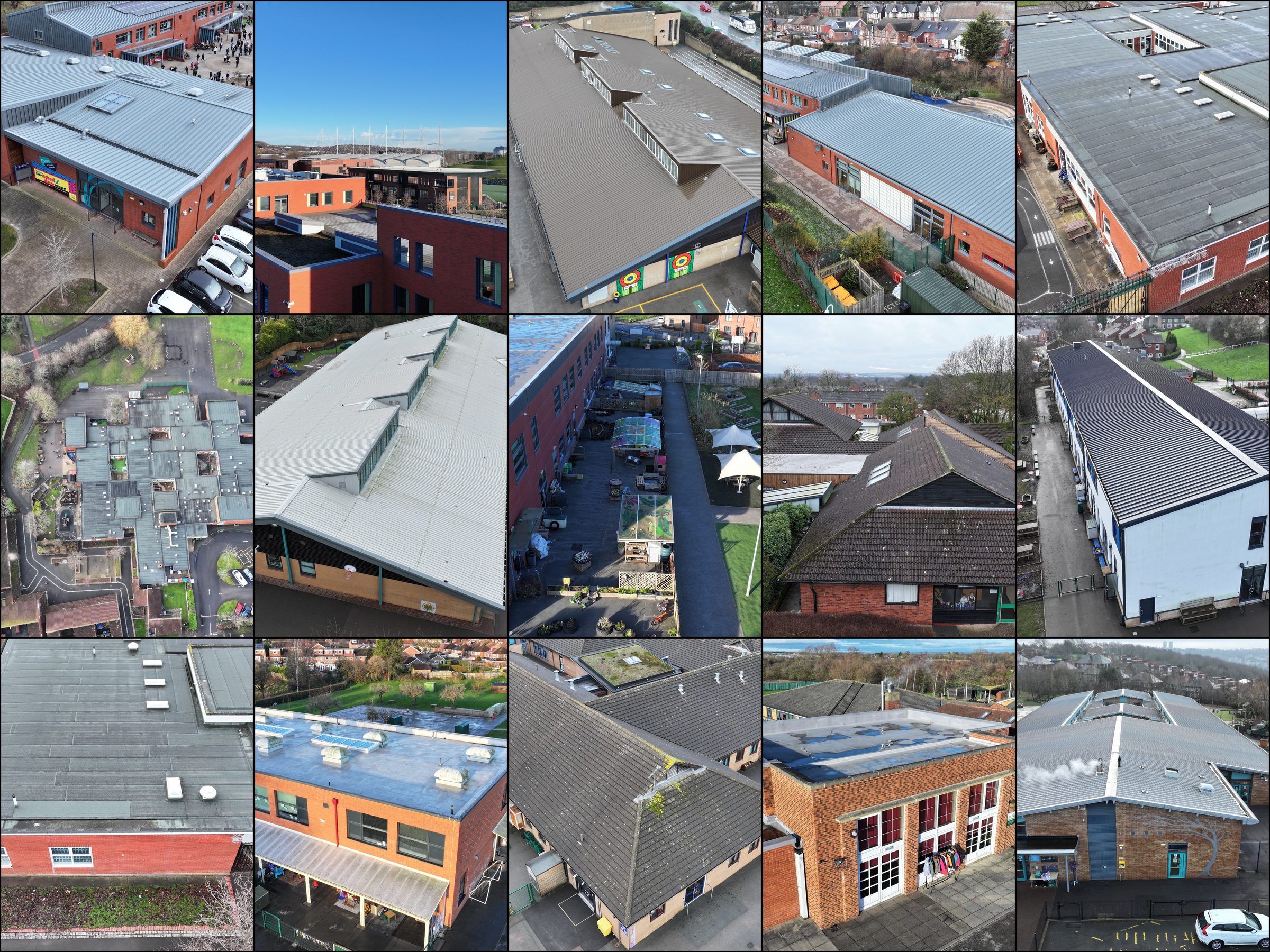
Under a public-sector schools solar programme, rooftop arrays were proposed across twenty separate school buildings. Twenty schools means twenty different construction dates, twenty roof types and twenty caretakers, but the programme needed one defensible engineering position, not twenty differently argued ones.
Sector
Education and public sector
Roofs assessed
20 school buildings
Scope
Structural roof loading appraisals, portfolio programme
Outcome
Every roof cleared for its array
The brief
School estates are the least homogeneous portfolios in the country. A single site can carry a Victorian block, a 1970s system-build teaching wing and a flat-roofed extension from last decade, and all three will answer the capacity question differently. Multiply that across twenty schools and the risk is not that any single roof fails; it is that the programme cannot say anything consistent about any of them.
The requirement was a structural position on every roof in the programme, delivered to a standard that would survive scrutiny from a funder, an insurer and a local authority estates team, and delivered fast enough to keep an installation programme moving.
A repeatable method, applied school by school
One consistent Eurocode-based method was applied to every roof in the programme. The method did not flex to suit the building; the assessment recorded what the building actually was.
- Individual structural loading appraisal per school, against that building's own construction, span, covering and exposure.
- Site-specific wind and snow actions derived per location to BS EN 1991-1-4 and BS EN 1991-1-3 with their UK National Annexes, rather than a single generic set applied across the portfolio.
- PV-specific uplift checked to BRE Digest 489 for each proposed array layout.
- A consistent report format, so a reader who has understood one report can read all twenty.
Working around a live school
Every building in the programme was occupied. Surveys were sequenced around the school day and the academic calendar, with roof-level capture handled by drone where access would otherwise have meant plant, exclusion zones or work in term time. A school is not a construction site, and the survey method has to accept that rather than argue with it.
What the programme found
| Assessment | Finding | Consequence for the scheme |
|---|---|---|
| Structural capacity, all twenty | Every roof across the portfolio confirmed capable of carrying its proposed array under the governing load combinations. | The whole programme de-risked. No structural strengthening line to carry into any of the twenty business cases. |
| Portfolio consistency | One method, one report format, twenty individually reasoned conclusions. | A funder or insurer reading any single report can rely on the same basis across the estate. |
| Roof variety | Mixed construction eras and roof types assessed individually rather than banded. | Buildings that look alike from the air were not assumed to behave alike. |
| Programme delivery | Twenty appraisals delivered at the pace the installation programme required. | Engineering did not become the bottleneck in the rollout. |
Every roof cleared is a good outcome. Every roof cleared, on a documented basis, in a format a third party can audit, is a programme outcome.
Outcome
All twenty school roofs confirmed for their proposed arrays, each signed individually.
A whole programme de-risked in one instruction, rather than school by school as each reached the front of the queue.
Genuine volume carried without dropping the standard. Portfolio work fails when rigour is traded for pace. Here the method was fixed and the throughput built around it.
Consistent, auditable documentation across a public-sector estate, suitable for funder and local-authority scrutiny.
What this means for school and public-sector estates
Public-sector solar programmes tend to stall in the same place: the estates team cannot get a consistent structural answer across a mixed portfolio, so the whole programme waits on the least understood building.
Three points read across to any multi-site public estate:
- Assess building by building, report to one standard. Those are not in tension. The method is fixed; the conclusion is specific.
- Derive wind and snow per site. A portfolio spread across a region does not share an exposure category, and the difference is not marginal.
- Start with the desktop tier where records exist. A Desktop Structural Roof Loading Report across the estate will identify the buildings that genuinely need an on-site survey, rather than paying for twenty visits to find the three that mattered.
Have a school or public-sector estate to assess? One method, every building.