Home / Case Studies / Flat Roof Split Verdict
Case Study · Recycling & Industrial
The structure passed. The covering did not.
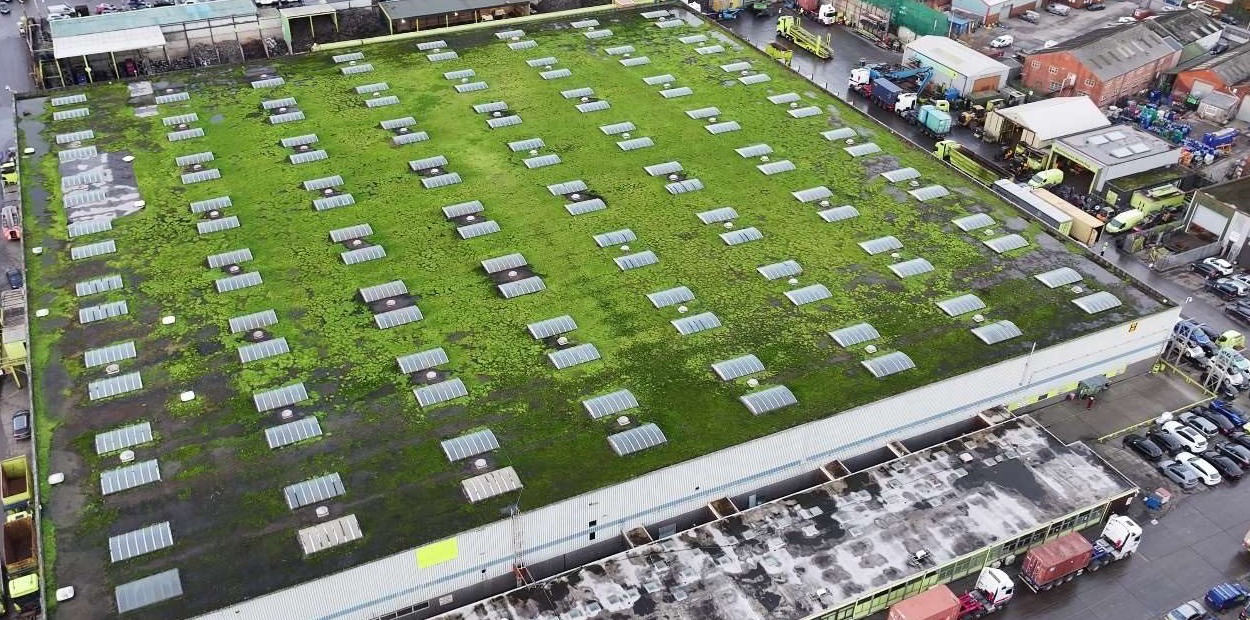
A renewable energy developer proposed a large rooftop array on the flat EPDM roof of a recycling and metals recovery facility — a single roof roughly 122 metres square. Two questions mattered equally, and they did not get the same answer. The structure was confirmed comfortably adequate. The covering was not, and we said so.
Sector
Recycling and industrial
Roof
Flat single-ply EPDM, approximately 122 m × 122 m
Structural verdict
Adequate. 0.448 kN/m² against 0.90 kN/m² allowable
Condition verdict
Covering remediation advised before installation
The brief
A single flat roof of roughly 122 metres square is an unusually good solar prospect. It is one uninterrupted plane, unshaded, on a site with heavy daytime electrical demand. It is also, at that scale, a very large area of single-ply membrane to be committing to for the next twenty-five years.
The developer needed two questions answered, and was clear that they were separate. Could the steel frame carry the array? And was the covering itself in a fit state to host panels for their design life? On a site of this type the second question matters as much as the first, because a panel installed over a failing membrane does not solve a problem. It moves it downstream, and puts an array on top of it.
How the roof was assessed
Structural loading analysis was paired with a candid condition survey, each carried out on its own terms.
- Measured survey of the roof structure, establishing the steel frame and deck from direct observation rather than record information.
- Full Eurocode loading assessment of the proposed PV against dead, imposed, snow and wind actions to BS EN 1991-1-1, BS EN 1991-1-3 and BS EN 1991-1-4 with their UK National Annexes.
- Drone-based condition survey across the full roof area — covering, drainage, upstands and penetrations, at a scale where a roof walk would have sampled a fraction of it.
- Mapping of surface defects, including the extent of moss and vegetation growth across the membrane.
Why area changes the method
At roughly 14,900 square metres, this is not a roof anyone inspects comprehensively on foot in a day. Drone capture across the whole plane produces a complete record rather than a representative sample, and on a defect like vegetation growth — which is patchy, spreads from the drainage lines outward, and is easy to under-report from ground level — completeness is the difference between a finding and an impression.
What the assessment found
| Assessment | Finding | Consequence for the scheme |
|---|---|---|
| Structural capacity | Combined PV and snow load established at 0.448 kN/m² against an allowable of 0.90 kN/m². | Comfortably within capacity. Zero strengthening works required to the structure. |
| Covering condition | Widespread moss and vegetation growth recorded across the EPDM membrane. | Remediation of the covering advised before any panels were fixed. |
| Drainage and penetrations | Outlets, upstands and penetrations recorded across the full roof plane. | Vegetation concentrated around drainage established as the pattern to address first. |
| Verdict structure | Two distinct conclusions issued rather than one blended opinion. | A client and a funder can act on each independently. |
The structural appraisal concluded that the existing roof structure is capable of accommodating the proposed PV loading; no additional strengthening works are required.
The condition survey recorded that the membrane exhibited widespread moss and vegetation growth… remediation of the covering is advised prior to installation to protect the roof over the life of the array.
Outcome
Structure de-risked. The array confirmed within the roof’s capacity by first-principles analysis, with no strengthening line to carry into the business case.
An honest condition finding. The covering was flagged before it became an expensive problem, rather than after an array had been fixed over it.
The asset protected. Advice framed around the roof surviving the full design life of the installation, not just the day of handover.
A split verdict a funder can rely on. The willingness to flag the covering is precisely what makes the structural pass credible.
What this means for large single-ply roofs
Large flat membrane roofs are the most common commercial solar target in the country, and the one where the structural answer is most often comfortable and the covering answer most often is not. The frame was never the risk here. The membrane was.
Three points read across:
- Ask for two verdicts, not one. A single overall opinion lets a covering problem hide behind a structural pass.
- Vegetation is a condition finding, not cosmetic. Moss holds moisture against a membrane and concentrates around drainage. It is a reasonable thing to require remediation for before committing an array over it.
- Survey the whole plane on a roof this size. A sampled roof walk across 14,900 square metres tells you about the part somebody walked on.
Where record information exists and the roof is not in doubt, this work can start as a Desktop Structural Roof Loading Report and escalate to an on-site structural survey and drone condition assessment where the engineering says so.
Got a large membrane roof to assess? Two verdicts, both straight.