The Minimum Energy Efficiency Standards (MEES) trajectory creates a hard deadline for commercial landlords: by 2030, new leases on commercial properties must meet EPC Band B. Properties currently rated D or below face a multi-band EPC improvement requirement, and rooftop solar PV is one of the most effective single measures available to close that gap.
This article explains the MEES timeline and its implications for commercial landlords, the structural requirements that must be satisfied before solar can be installed as an EPC improvement measure, and how to integrate the structural workstream into a portfolio-level MEES programme.
The MEES Timeline for Commercial Landlords
MEES was introduced under the Energy Efficiency (Private Rented Property) (England and Wales) Regulations 2015. The regulatory trajectory for commercial (non-domestic) property is:
- April 2023: Minimum EPC E required for all commercial lettings, including existing leases. Properties rated F or G cannot legally be let.
- 2027 (proposed): Minimum EPC C for new leases.
- 2030 (proposed): Minimum EPC B for new leases, and EPC C for all existing commercial leases.
- 2033 (proposed): Minimum EPC B for all commercial leases, including legacy.
The 2027-2033 milestones remain subject to legislative confirmation, but the direction is unambiguous: the permitted EPC floor will rise substantially over the next decade, and properties that do not invest in energy efficiency improvements will become unlettable.
Commercial EPCs use the Simplified Building Energy Model (SBEM) or Dynamic Simulation Modelling (DSM). The rating reflects the building's theoretical energy performance based on fabric, services, and fixed installations, not actual energy consumption. Solar PV contributes to the EPC rating by reducing the calculated net energy consumption of the building, with the contribution dependent on array size, orientation, system efficiency, and the building's baseline consumption.
How Solar PV Improves Commercial EPC Ratings
Rooftop solar PV improves a commercial EPC rating through two mechanisms. First, it reduces the net energy consumption attributed to the building in the SBEM/DSM model, directly lowering the kWh/m² figure that drives the rating. Second, by generating renewable electricity on-site, it reduces the primary energy factor applied to the building's electricity consumption.
The magnitude of the EPC improvement depends on array size relative to building floor area, orientation and shading, and the building's baseline consumption. For a typical large commercial building rated EPC D or E, a correctly sized rooftop array can improve the rating by one to three bands, enough in many cases to bridge from D to B or from E to C.
For landlords facing the 2030 EPC B requirement, solar PV is particularly attractive because it can deliver a large EPC improvement in a single measure, without the disruption of fabric interventions (insulation, window replacement) that may be incompatible with tenant occupation or listed building status.
The Structural Requirement That Cannot Be Skipped
For solar to contribute to an EPC improvement, it must be installed. For it to be installed safely and in compliance with MCS standards (required for SEG eligibility and lender acceptance), the roof must have a structural sign-off from a structural engineer. This requirement applies regardless of the EPC improvement rationale, it is not possible to install solar to satisfy MEES without first satisfying MCS MIS 3002 Section 5.9.
For commercial portfolios, this means every property targeted for solar as part of a MEES compliance programme must pass a structural assessment. The structural workstream cannot be compressed out of the programme, it is a non-delegable condition of installation.
The structural risk varies significantly by building type:
- Modern steel-frame warehouses (post-1990): Generally well-documented, often have residual structural capacity, desktop reports typically sufficient
- 1970s, 1980s portal frame sheds: Higher risk, original purlins may be light gauge, drawings often absent, site surveys frequently required
- Multi-storey office buildings: Roof plant loads may already consume much of available capacity; structural assessment critical
- Mixed-use and listed properties: Heritage constraints intersect with structural requirements; listed building consent may be required alongside structural sign-off
Portfolio-Level Structural Triage
For landlords with portfolios of ten or more properties targeting MEES compliance, commissioning individual structural assessments sequentially is inefficient. A portfolio structural triage, a rapid desk-based screening of each property's structural viability for solar, allows resources to be concentrated on properties most likely to pass full assessment and most in need of EPC improvement.
Tenant Interaction and Consent Requirements
Commercial landlords installing solar for MEES compliance on occupied properties must navigate lease terms, tenant consent requirements, and the interaction between landlord improvements and tenant obligations. Key considerations:
Landlord and Tenant Act access: Landlords generally have rights under standard commercial leases to access the roof for maintenance. Installing plant on the roof, a more substantial intervention, may require the tenant's consent under the lease or quiet enjoyment provisions. Legal review of specific lease terms is required before installation begins.
MEES exemptions: MEES provides for a "third-party consent" exemption where a landlord has been unable to obtain tenant consent for improvement works, and consent was withheld unreasonably. However, claiming this exemption requires documented evidence that consent was sought and refused. It is not a mechanism for bypassing tenant consultation.
Benefit allocation: The electricity generated by the solar array may flow to the common parts or to the landlord, or may be sold directly to the tenant at a discounted rate under a sub-PPA. The commercial terms of benefit allocation affect the attractiveness of the investment to both parties and should be agreed before structural assessments are commissioned.
The Cost Case for Early Action
The cost trajectory for MEES compliance moves in one direction only: properties that defer action to 2029 will face compressed construction timelines, premium contractor rates, and, if they fail to comply, the cost of being unlettable. The current supply of structural engineers and solar installers can absorb a gradual compliance programme; the market cannot absorb a portfolio of commercial landlords all attempting compliance in the same eighteen-month window.
Structural assessments commissioned now have a long shelf life: a report produced in 2025 for a 2027 installation is valid for most purposes. The cost of commissioning structural surveys across a portfolio is modest relative to the MEES compliance risk, and the surveys provide value beyond MEES compliance, informing asset management decisions, lease renewals, and disposition valuations.
Integrating Structural Surveys into MEES Compliance Programmes
The most efficient approach for commercial landlords is to integrate structural survey commissioning into the existing portfolio management cycle, alongside quinquennial surveys, insurance renewal, and rent review triggers, rather than treating it as a separate MEES exercise. Properties due for routine building surveys in the next two years can have a structural solar viability assessment added at marginal cost. Properties with upcoming lease renewals should have structural viability assessed before renewal negotiations, so that the landlord knows whether solar is an option that can be offered to anchor tenants as part of a green lease.
Framework agreements with structural engineering firms, fixed rates, agreed scope, 48-hour target turnaround for desktop reports, allow portfolio managers to commission assessments on a rolling basis without procurement overhead on each instruction.
Structural Assessment as MEES Compliance Evidence
For commercial landlords using solar PV as an EPC improvement measure, the structural assessment serves a dual purpose: it confirms the roof can carry the installation (the standard structural sign-off purpose), and it contributes to the MEES compliance evidence package by confirming that the installation was conducted to a professional engineering standard. Enforcement authorities investigating MEES compliance will want to see evidence that any EPC improvement measures were properly commissioned and installed, a structural sign-off from a structural engineer is one component of that evidence.
MEES compliance documentation for solar installations should include:
- Structural sign-off letter from structural engineer
- MCS certificate confirming the installation meets the certification standard for SEG eligibility
- Confirmation that the updated EPC has been lodged on the EPC register following installation
- Record of the before and after EPC ratings, confirming the required band improvement was achieved
EPC Assessment Methodology: What Solar PV Actually Delivers
Commercial EPCs are calculated using SBEM (Simplified Building Energy Model) or, for complex buildings, DSM (Dynamic Simulation Modelling). Solar PV contributes to the EPC rating by reducing the net energy consumption of the building, the electricity generated on-site offsets consumption that would otherwise be drawn from the grid.
The EPC improvement from solar PV is quantified as the reduction in the building's annual energy demand per unit floor area (kWh/m²/year). The magnitude of this improvement depends on the array size relative to the building's floor area, the orientation and shading of the panels, and the building's baseline consumption, a building with high electricity consumption per m² will see a larger proportional improvement than a low-consumption building with the same array size.
Landlords should obtain an indicative EPC assessment from an accredited assessor before commissioning the solar installation, to confirm the expected band improvement is achievable with the proposed array size. An array sized to improve the EPC from D to C might not achieve D to B, and confirming this before the structural assessment is commissioned avoids investing in a structural survey for a system that will not deliver the required compliance improvement.
Interaction Between MEES Compliance and Lease Terms
Commercial leases that pre-date MEES often do not address the landlord's obligation to improve EPC ratings, or address it inadequately. Green lease clauses, provisions requiring the landlord to maintain the building above a minimum EPC rating, and the tenant to co-operate with improvement works, are increasingly standard in new institutional leases, but older leases may have no such provisions.
Where a lease does not include green provisions, the landlord's ability to install solar for MEES compliance may depend on:
- Whether the lease permits the landlord to make alterations (solar is typically a structural alteration requiring landlord consent, but the landlord is the installer here)
- Whether the tenant's quiet enjoyment rights are affected by the installation (typically they are not for rooftop solar that does not affect the occupied premises)
- Whether the lease requires the landlord to maintain the building in a specific condition (solar installation changes the roof surface, which may trigger lease compliance considerations)
Legal advice on the specific lease terms is required before committing to structural assessment and installation. The structural survey is a relatively inexpensive step; lease-driven legal delays or disputes are expensive. Legal clearance should precede or run concurrently with structural assessment, not follow it.
The MEES Compliance Pathway: Solar PV as an Improvement Measure
The Minimum Energy Efficiency Standards (MEES) for commercial non-domestic properties in England and Wales require that rented buildings meet a minimum Energy Performance Certificate (EPC) rating as a condition of a valid lease. The government’s trajectory, currently EPC E minimum (enforceable since 2023), with consultation progressing toward EPC B by 2030, creates a substantial compliance obligation for commercial landlords whose properties fall below the target EPC rating.
Solar PV installation is an effective EPC improvement measure for commercial buildings with high unmetered grid energy consumption. A building whose EPC rating is limited by its energy consumption from the grid can improve its rating by reducing grid dependency through onsite solar generation. The SAP or SBEM calculation used for commercial EPC assessments credits on-site renewable generation, which reduces the calculated notional energy import and improves the EPC rating. The magnitude of the improvement depends on the building’s baseline energy use, the solar system’s generation profile, and the self-consumption rate, for commercial buildings with high weekday daytime consumption, self-consumption of solar generation is typically high, maximising the EPC rating benefit.
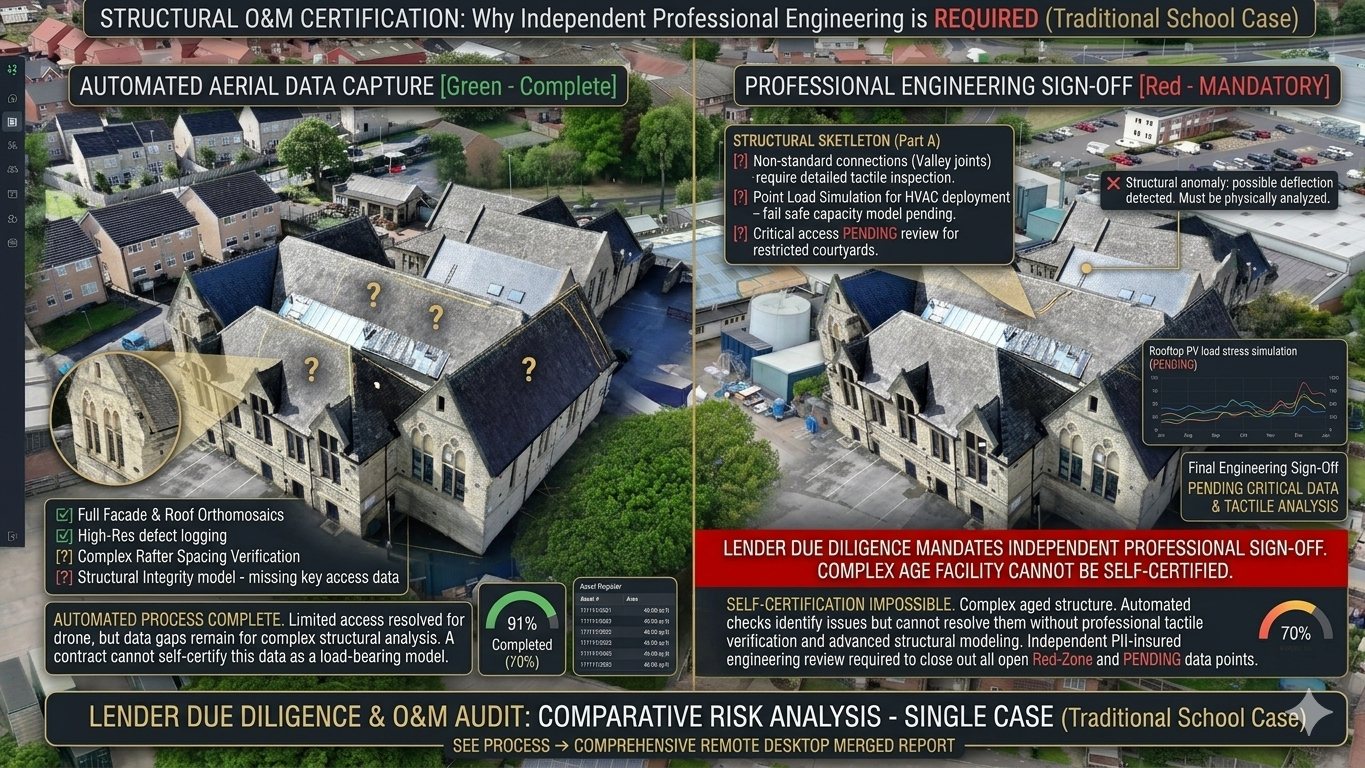
The structural clearance for the solar installation is a prerequisite of the EPC improvement pathway. A landlord who proposes solar PV as an EPC improvement measure in their MEES compliance plan must be able to demonstrate that the installation is structurally viable, otherwise the proposed measure cannot be implemented and the compliance plan is defective. Obtaining structural clearance early in the MEES compliance process, alongside the EPC assessment and energy improvement analysis, confirms that the solar measure is deliverable within the compliance programme timeframe.
Structural Evidence in MEES Compliance Documentation
MEES compliance documentation for commercial landlords affected by the 2030 EPC B trajectory will need to demonstrate that measures have been implemented or are programmed and funded, within the regulatory compliance framework. Where solar PV is included as an improvement measure, the compliance documentation should include structural clearance evidence as part of the technical evidence that the measure is viable and implementable.
The role of structural clearance in MEES compliance documentation is analogous to its role in MCS certification: it confirms that the proposed installation can physically be built on the building without structural risk, which is a prerequisite of the installation being delivered and the EPC improvement being realised. An EPC improvement plan that proposes solar PV but does not include structural clearance evidence may be challenged by compliance auditors or, in the event of enforcement action, by local weights and measures authorities responsible for MEES enforcement under the Energy Efficiency (Private Rented Property) (England and Wales) Regulations 2015.
Landlords managing multiple commercial properties under the MEES compliance obligation should consider portfolio structural assessment as part of their MEES compliance planning. A desktop structural assessment of each property proposed for solar improvement confirms the structural viability of the measure before significant investment in EPC modelling, energy improvement scoping, or contractor procurement. Identifying properties where structural clearance is problematic at the planning stage allows the compliance programme to substitute alternative improvement measures for those properties rather than discovering the structural constraint after the improvement pathway has been committed.
Commercial landlords assessing rooftop solar as an EPC B compliance route should commission structural assessment as part of the feasibility stage, not after planning or design has been committed. A desktop structural report at feasibility stage confirms whether the building is structurally suitable for the array size required to achieve the target EPC rating, identifies any strengthening requirements that would affect project economics, and can be produced from available drawings without site disruption. At on application per report for standard commercial buildings, the cost of structural feasibility is immaterial relative to the investment decision it informs.
WHERE SOLAR SURVEYS ADDS VALUE
MEES COMPLIANCE STRUCTURAL ASSESSMENT, PART OF YOUR EPC B PATHWAY
Solar Surveys provides desktop structural assessments for commercial landlords using solar PV as an EPC improvement measure under their MEES compliance programme. Reports confirm structural viability of the proposed installation and are issued in a format compatible with MEES compliance documentation requirements. Portfolio batches for landlords with multiple properties assessed within a defined programme window, with reports structured to confirm which properties can proceed to installation and which require alternative improvement measures.
CLIENT PROFILE
A commercial property company with 18 industrial and retail units facing MEES compliance obligations instructed desktop structural assessments for all 18 properties as part of their EPC B compliance review. Fourteen buildings received unconditional structural clearance for the proposed solar PV installation. Three received conditional clearances that were compatible with the planned racking systems. One building, a 1968-era warehouse with significant structural deterioration identified in the desktop review, was recommended for on-site structural investigation before a clearance verdict could be issued, and an alternative EPC improvement measure was incorporated into that property’s compliance plan while the structural investigation was arranged. The portfolio assessment was completed within 48 hours, enabling the company’s compliance manager to finalise the improvement programme before the planning year deadline.
THE STRUCTURAL TRINITY
Three Reports That Clear a Commercial Solar Site for Installation
READY TO COMMISSION
Get a Quote in 24 Hours.
Structural surveys, Desktop Structural Roof Loading Reports, drone assessments and solar design packages, delivered to a 48-hour benchmark.
Get a Quote