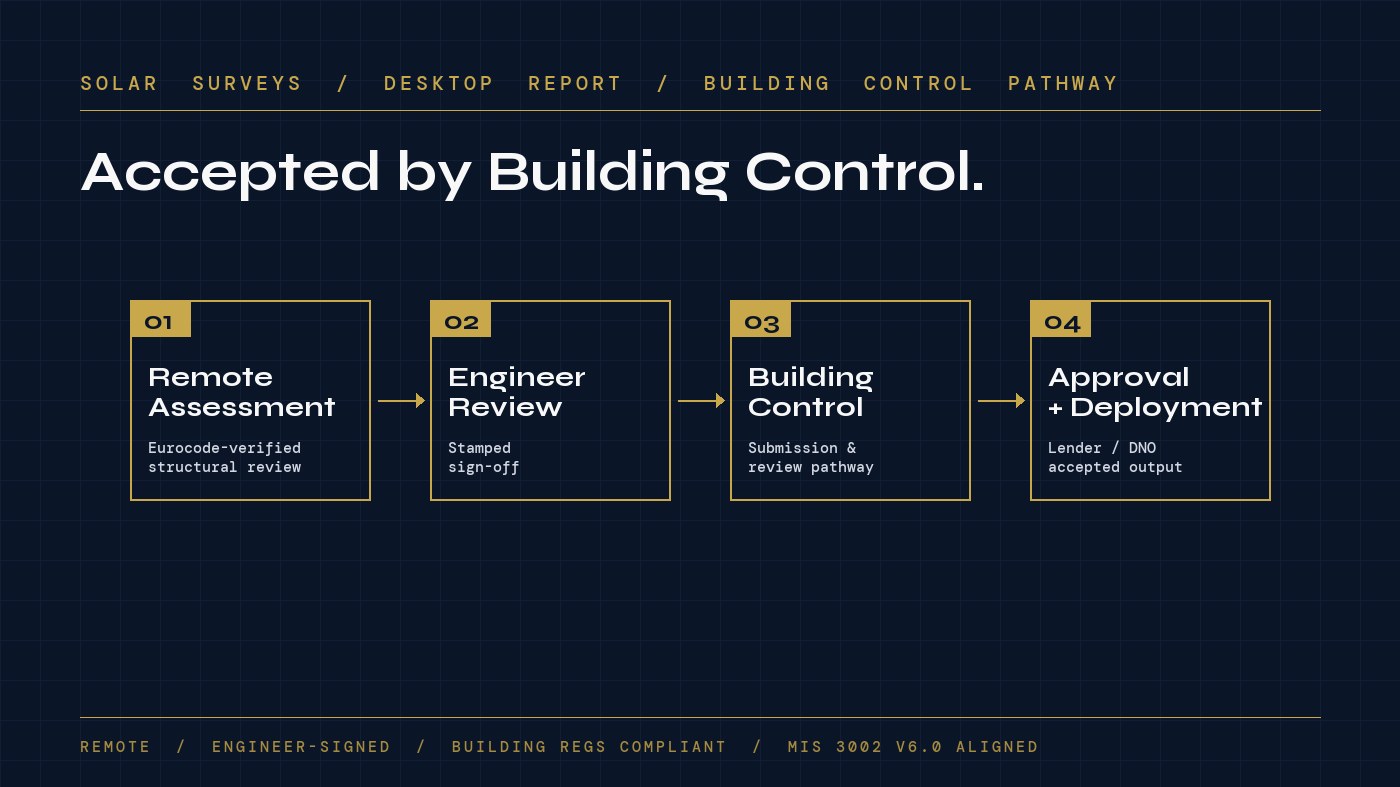
MCS MIS 3002 V6.0 is the Microgeneration Certification Scheme installation standard for solar photovoltaic systems. Section 5.9 is the clause that governs structural assessment. It is not guidance, it is a certification requirement. An MCS-certified installer who proceeds to install a commercial rooftop solar array without satisfying Section 5.9 is in breach of their certification conditions, regardless of whether the installation is structurally sound.
The question that project teams, EPC contractors, and certified installers consistently ask is this: does a desktop structural report, an assessment produced without a physical site visit, satisfy Section 5.9, or does the standard require an on-site inspection? The answer matters commercially. On-site surveys cost more and take longer. If a desktop report is compliant, commissioning an on-site survey in its place adds cost and programme time without benefit.
The definitive answer is that a desktop structural report satisfies MIS 3002 Section 5.9 when it is produced by a suitably qualified structural engineer and contains the content the standard requires. Section 5.9 specifies qualification and content, it does not mandate a site visit. This article examines the clause in detail: what it requires, who qualifies to sign a compliant report, what the written confirmation must contain, and the specific circumstances in which a desktop assessment cannot satisfy the standard.
What Section 5.9 of MIS 3002 V6.0 Actually States
Section 5.9 requires that, before a commercial solar PV installation proceeds, the installer obtains written confirmation from a suitably qualified structural engineer confirming that the proposed installation is structurally acceptable for the building concerned. The written confirmation must address the capacity of the existing roof structure to carry the additional dead load of the PV array and its racking system, the adequacy of the fixing arrangement to resist wind-induced uplift forces acting on the array, and any structural constraints or conditions that affect how the installation must be specified or executed.
The standard uses the phrase "suitably qualified structural engineer" and defines what that means. It does not use the phrase "site visit", "physical inspection", or "on-site attendance". The requirement is defined in terms of who produces the confirmation and what it must contain, not the methodology by which the engineer conducts their assessment.
This distinction is critical. Many installers and developers have been advised, incorrectly, that Section 5.9 requires a physical site inspection. This misunderstanding has commercial consequences: it leads to on-site surveys being commissioned for standard commercial buildings where a desktop assessment would be fully adequate, adding unnecessary cost and programme delay to projects that did not require it.
The compliance question is not "desktop or on-site?" It is: "does the written confirmation come from a suitably qualified engineer and does it contain all required content?" If yes, the methodology is irrelevant to compliance.
The Qualification Requirement, Who Can Sign a Compliant Report
Section 5.9 defines "suitably qualified structural engineer" by reference to professional body membership. The qualifications that satisfy the standard are: Member of the Institution of Structural Engineers (professional qualification), Fellow of the Institution of Structural Engineers (suitably qualified structural engineer), Member of the Institution of Civil Engineers , and Fellow of the Institution of Civil Engineers (suitably qualified civil/structural engineer).
The following designations do not satisfy Section 5.9, regardless of the report's content:
- Assessments signed by energy assessors or renewable energy consultants without structural engineering qualifications
- Assessments signed by general practice surveyors (RICS designation is not sufficient)
- Assessments produced by architectural technicians
- Assessments produced by engineering technicians without structural engineer status
- Self-certified assessments completed by the installer or their in-house technical team
The report must be signed and dated by the named qualified engineer. A report that references a structural engineer's name in a header but carries no signature does not satisfy the standard. The signature is a professional declaration, the engineer is personally and professionally responsible for the assessment, and their registration with IStructE or ICE is the mechanism that underpins that accountability.
For project teams reviewing structural reports submitted by installers or third parties, the verification process is straightforward. Locate the engineer's name and professional designation on the report. If the designation is suitably qualified structural engineering professional, the qualification requirement is met. If in doubt, both the IStructE and ICE maintain publicly searchable online registers that confirm current membership status.
This qualification requirement applies identically to desktop reports and on-site surveys. There is no reduced qualification standard for remote assessments. The engineer's professional status is a fixed requirement regardless of how the assessment was conducted.
What the Written Confirmation Must Contain
A signed report from a qualified engineer is necessary but not sufficient. The written confirmation must also contain the specific content Section 5.9 requires. Reports that are well-intentioned but incomplete fail compliance checks as readily as unqualified assessments.
The written confirmation must address the following:
Site-Specific Identification
The report must identify the specific building and proposed installation by address, building description, and array size. Generic template statements are non-compliant even when signed by qualified engineers.
Dead Load Adequacy
The report must confirm that the existing roof secondary structure can carry the additional dead load of the proposed array and racking system without overstressing primary or secondary members, with reference to the calculated stress levels and design capacity.
Wind Uplift Adequacy
The report must confirm that the fixing arrangement can resist the design wind uplift forces for the specific site, array geometry, and roof type. Wind uplift is typically the critical load case; reports that omit this check are structurally incomplete regardless of their status on dead load.
Design Standards Referenced
The report must identify the Eurocode standards applied, EN 1991-1-4 for wind actions, EN 1993-1-3 for cold-formed steel sections, and the relevant UK National Annexes, and the engineer's professional qualifications.
Conditions and Constraints
Where clearance is conditional, subject to a maximum panel weight, minimum fixing density, or roof zone restrictions, those conditions must be explicitly stated. An unconditional clearance on a building with actual structural constraints is not only non-compliant; it creates professional liability for the engineer.
Does a Desktop Report Satisfy Section 5.9? The Definitive Answer
Yes. A desktop structural report satisfies MIS 3002 Section 5.9 when it is produced by a suitably qualified structural engineering professional-qualified engineer and contains all required content. The assessment methodology, remote or on-site, is not a compliance variable.
For standard UK commercial and industrial buildings constructed after approximately 1970, desktop assessment is not only compliant but is the appropriate product. Steel portal frame warehouses, light industrial units, and modern logistics buildings follow well-understood structural typologies. An experienced structural engineer who has assessed hundreds of similar buildings carries the reference data to make credible engineering assumptions without visiting every site. Where structural drawings are also available, which they typically are for post-1990 buildings, the desktop assessment can be as definitive as an on-site inspection for standard construction.
Section 5.9 compliance is determined by engineer qualification and report content, not by whether the engineer visited the site. For standard commercial buildings, a desktop report from a qualified engineer is a fully compliant structural assessment.
This position is consistent with how MCS Certification Bodies conduct compliance inspections in practice. Auditors examine the qualification of the signing engineer, the site-specific nature of the assessment, the presence of dead load and wind uplift calculations, and the statement of any conditions. They do not ask whether the engineer attended site, because Section 5.9 does not require them to.
When a Desktop Report Cannot Issue MIS 3002-Compliant Clearance
While desktop methodology is compliant under Section 5.9, there are specific circumstances where a desktop assessment cannot reach a definitive engineering verdict. In those cases, the desktop report appropriately concludes with a referral to on-site survey.
These circumstances include buildings constructed before approximately 1960, where structural typologies are highly variable and cannot be reliably assessed from remote data alone. They also include non-standard or hybrid construction where typology benchmarks do not apply, buildings without structural drawings where the construction type cannot be determined from remote data, and buildings where the desk assessment indicates that loading is at or near the estimated structural capacity margin and the engineering margin for assumption error is too small to issue a definitive clearance.
In these cases, the desktop report is not a compliance failure, it is an accurate and conservative engineering assessment that identifies what additional data a site visit would resolve. The desktop report becomes the technical brief for the on-site survey, specifying exactly which questions need answering before sign-off can be issued. The referral to site survey is the correct professional response when data is insufficient for a remote conclusion.
Project teams should note that the referral outcome is not a problem with the desktop assessment process. It is evidence that the process is working correctly. A desktop assessment that always produces clearance regardless of building condition is more concerning than one that appropriately identifies the limits of what can be concluded remotely.
What the MCS Certification Body Looks for in an Inspection
Understanding what MCS auditors examine helps project teams and installers ensure their structural documentation is ready for inspection before it is tested.
The MCS Certification Body's inspection will verify: that the report names a qualified engineer with a stated IStructE or ICE membership; that the report is signed and dated; that the report is site-specific and addresses the installation for which sign-off is claimed; that dead load and wind uplift adequacy are both addressed; that any conditions on clearance are stated; and that the report was produced before installation commenced rather than retrospectively.
Retrospective structural reports, produced after installation has commenced or been completed, represent a compliance risk. Section 5.9 requires written confirmation before installation proceeds. Auditors note report dates and compare them to installation records. Where the report date follows the installation start date, the installer faces a compliance question. Commission structural reports before mobilisation, not after.
Auditors also check that the conditions stated in structural reports have been communicated to and complied with by the installation team. A conditional clearance (e.g., maximum panel weight of 15 kg/m², minimum fixing spacing of 600 mm centres) that was stated in the report but not applied during installation represents both a structural risk and a compliance failure. The structural report and the installation specification must be consistent.
Common Section 5.9 Compliance Failures and How to Avoid Them
The following compliance failures appear most frequently in MCS certification inspections and due diligence reviews:
Wrong qualification. Reports signed by energy assessors, renewable energy consultants, or general surveyors without IStructE or ICE membership fail the qualification check. Always verify the signing engineer's membership designation before accepting a structural report as MIS 3002-compliant.
Generic template report. A single-page letter stating that a building "appears suitable" without site-specific calculations or reference to the proposed array parameters does not meet Section 5.9 content requirements. Every compliant report must be specific to the building and installation being assessed.
Wind uplift omission. Reports that confirm dead load adequacy but omit wind uplift analysis are incomplete. Wind uplift is typically the critical load case for rooftop solar arrays. Its omission is a substantive gap that auditors consistently identify and that lenders' technical advisers invariably query.
Unsigned or undated report. An unsigned structural assessment has no professional standing. A report without a date cannot be verified as preceding installation. Both signatures and dates are mandatory.
Conditions not communicated to site team. A conditional clearance that is not communicated to the installer is operationally useless and represents a compliance and safety risk. Structural reports with conditions must be reviewed by the installation design team before specification is finalised.
Report produced after installation. This is the most serious compliance failure. Once installation has commenced, Section 5.9 has already been breached. Commissioning a structural report post-installation does not remedy the breach, it merely creates a document that post-dates the event it was supposed to precede.
Coordinating Structural and Electrical Documentation for MCS Certification
MCS certification for commercial solar installations involves a documentation package that extends beyond the structural report itself. Under MIS 3002, the structural clearance forms one element of the technical evidence package required for certification. The full certification package also includes: the electrical design and installation specification; confirmation of compliance with the relevant wiring regulations; details of the proposed metering and grid connection arrangement; product certification confirming that the PV panels and inverter are MCS-listed or equivalent; and installer certification confirming that the installation company holds current MCS accreditation for the relevant technology type. The structural report must be coordinated with the electrical design so that the panel layout, mounting system, and installation details referenced in the structural clearance match exactly the installation as built. Post-installation changes to the array layout, additional panels, changed row spacing, or different mounting heights, that are not reflected in the structural documentation create a discrepancy between the certified design and the as-built installation that may need to be resolved before the MCS certificate can be issued.
A coordination protocol between the EPC, the structural engineer, and the MCS certification body that requires confirmation of any post-design changes before they are implemented in the field, rather than retrospective resolution after installation, prevents the majority of certification delays arising from structural documentation inconsistencies. For larger commercial projects involving multiple installation phases, this protocol becomes proportionally more valuable as the risk of phased changes creating undocumented discrepancies between design and as-built increases with project scale and duration.
Where an installation proceeds in phases, a phased array build-out over successive budget years, for example, the MCS certification documentation should reflect this from the outset. A structural report that clears the full eventual array size at the first phase avoids the need for supplementary structural assessments at each subsequent phase, provided the as-built installation at each phase remains within the parameters of the original clearance. Confirming this approach with the MCS certification body at the design stage rather than retrospectively is standard practice for larger phased commercial installations, and it prevents the certification documentation from becoming fragmented across multiple reports that are difficult to reconcile against the as-built scope.
WHERE SOLAR SURVEYS ADDS VALUE
MIS 3002 SECTION 5.9 COMPLIANT, EVERY REPORT, EVERY INSTRUCTION
Every desktop structural report Solar Surveys produces is signed by a qualified structural engineer, addresses dead load and wind uplift for the specific site and array, and is formatted to satisfy MCS MIS 3002 Section 5.9 from first issue. We provide a compliance reference sheet with each report identifying the Section 5.9 elements addressed, simplifying the installer's MCS audit process. Delivery benchmark is 48 hours from receipt of complete information for individual sites and portfolio batches.
CLIENT PROFILE
An MCS-certified installer managing a pipeline of 34 commercial rooftop sites was experiencing repeated compliance queries from their certification body regarding structural documentation. Several reports in their project files had been produced by energy assessors rather than qualified structural engineers, and none contained explicit wind uplift calculations. Solar Surveys produced MIS 3002 Section 5.9-compliant desktop structural reports for all 34 sites. The installer's next MCS certification audit resulted in clearance with no structural documentation queries raised.
THE STRUCTURAL TRINITY
Three Reports That Clear a Commercial Solar Site for Installation
READY TO COMMISSION
Get a Quote in 24 Hours.
Structural surveys, Desktop Structural Roof Loading Reports, drone assessments and solar design packages, delivered to a 48-hour benchmark.
Get a Quote